City Council Meeting Summary, May 11, 2026
Published on May 26, 2026
City Council Receives Proposed Budget, Approves Digital Kiosk Program, Interim SB 79 Zoning Standards
Receives Fiscal Year 2026–2027 Proposed Budget and KPI Framework
The City Council received the City Manager’s proposed Fiscal Year 2026–2027 Budget, along with an overview of the City’s Key Performance Indicator framework and set the public hearing for budget adoption for June 8, 2026, at 7 PM.
The proposed budget was presented as balanced and aligned with the City Council’s strategic priorities: strengthening long-term financial sustainability, investing in public infrastructure and community spaces, and enhancing affordability while addressing housing and homelessness. The budget strategy focuses on preserving core services, restoring fiscal discipline, managing vacancies, improving cost controls, implementing revenue enhancements, and avoiding layoffs.
Staff presented planned investments in affordable housing, small business support, parks, streets, alleys, tree canopy maintenance, safe street corridors, sewer and stormwater repairs, facilities, technology, and other capital improvements. The budget also incorporates use of the Public Finance Authority as a financing tool to support long-term investments while helping restore reserves and reduce near-term General Fund pressure.
Council discussion included support for the “back-to-basics” focus on streets, sidewalks, parks, trees, alleys, and other quality-of-life infrastructure, as well as appreciation for the budget’s transparency, the commitment to avoiding layoffs, restoration of Housing Authority funds, and progress toward rebuilding reserves. Council Members also raised questions about the balance of investments across infrastructure categories, safe street corridors, neighborhood-level equity, community event fees, fire inspection fees, the Mobile Crisis Team, and future housing stability tools.
Council also received an update on the City’s KPI framework, including an initial set of 25 verified indicators tied to City Council priorities and a larger library of performance measures under development. Staff plans to continue refining the framework, develop a public-facing dashboard, and use performance data to improve transparency, accountability, and community understanding of budget decisions.
Community engagement remains part of the budget process, with upcoming community conversations, an online survey, a budget input box, and additional opportunities for public input and Council deliberation before final budget consideration. Staff will compile feedback from community sessions and the survey for Council review before the May 26 budget discussion.
Approves Siting Plan for Interactive Digital Kiosk Program
The City Council approved the Phase I siting plan for the City’s Interactive Digital Kiosk Program, allowing implementation of 15 digital kiosks with commercial advertising along City sidewalks and in the public right-of-way.
The program, operated by Ike Smart City LLC, is expected to generate new City revenue through a one-time installation bonus and annual minimum revenue guarantees for each operating kiosk. Staff noted that the siting plan had been reviewed for feasibility and public right-of-way requirements, with public input gathered through a community meeting, website posting, business outreach, and BPAC-related discussions.
Council discussion focused on the public right-of-way, safety considerations, prior public review, potential BPAC input, and concerns about one proposed location near a historic Arts District bench. As part of the approval, Council directed staff to explore relocating Site 12 to the south side of Washington Boulevard and, if that location is infeasible, to replace Site 12 with Site 24 at Washington Boulevard and La Cienega Boulevard.
Council Member Dan O’Brien recused himself from the item due to a potential conflict of interest identified by the FPPC. The motion passed with Mayor Freddy Puza and Council Member Albert Vera voting in favor. Vice Mayor Bubba Fish and Council Member Yasmine-Imani McMorrin abstained. Staff also agreed to continue working with BPAC to obtain additional input while moving forward with implementation.
Receives Job Vacancy, Recruitment, and Retention Update
The City Council received a presentation on the City’s job vacancies, recruitment efforts, and employee retention strategies as required by Assembly Bill 2561.
The report noted that AB 2561 requires public agencies to annually track, analyze, and publicly report job vacancy data, recruitment challenges, and retention efforts. City staff presented vacancy information for calendar year 2025, including a year-end vacancy rate of 10.05 percent and a running average vacancy rate of 8.47 percent. Staff also highlighted departments with higher vacancies, including Housing and Human Services, PRCS, and Transportation.
The presentation also covered recruitment activity, including 85 full-time recruitments and 133 full-time hires in 2025, along with ongoing challenges such as a competitive labor market, attracting qualified candidates, accelerating hiring timelines, and adapting to pension reform impacts. Staff discussed strategies to improve recruitment, including targeted advertising, faster review processes, same-day hiring where appropriate, partnerships with schools, and sign-on and referral bonuses.
Council received the update following a public hearing. Staff also described retention efforts such as expanded employee benefits, hybrid work schedules, wellness programs, employee engagement initiatives, recognition events, recruitment and referral incentives, and competitive salaries.
Introduces Interim SB 79 Zoning Standards
The City Council unanimously introduced an ordinance approving interim Zoning Code amendments to implement Senate Bill 79, the Abundant and Affordable Homes Near Transit Act, with the condition that the ordinance will not take effect until SB 79 becomes effective.
SB 79 establishes new development standards for certain transit-oriented housing projects within a half-mile of qualifying transit stops. Culver City is expected to be affected by four Tier 2 transit locations, with standards varying based on distance from each stop. The interim ordinance creates local standards for qualifying projects while the City continues work on a longer-term Transit-Oriented Development (TOD) Alternative Plan intended to concentrate density along major transit corridors rather than applying density uniformly across affected areas.
Council discussion focused on potential impacts to traditionally Single Family Residential neighborhoods, the timing of development applications, pending SB 79 maps, interaction with SB 330, and whether existing local development standards could conflict with SB 79 requirements. Council also requested additional analysis before the ordinance’s second reading on how existing Residential Medium Density standards may apply and what process would be used if conflicts arise.
The ordinance is intended as an interim step while the City develops its TOD alternative plan, which is expected to begin in July 2026 and take approximately six to ten months.
Recognitions, Commendations & Proclamations
The City Council proclaimed May 2026 as Jewish American Heritage Month in Culver City, honoring the contributions of Jewish Americans to the nation’s history, culture, civic life, arts, sciences, education, business, and public service. The proclamation also reaffirmed the City’s commitment to diversity, inclusion, combating antisemitism, and standing against all forms of hate.
The City Council proclaimed May 2026 as Older Americans Month in Culver City, recognizing the vitality, accomplishments, and contributions of older adults. This year’s theme, “Champion Your Health,” encourages older adults to stay active in their health and wellness through preventative care, social connection, and daily habits that support mental health and resilience.
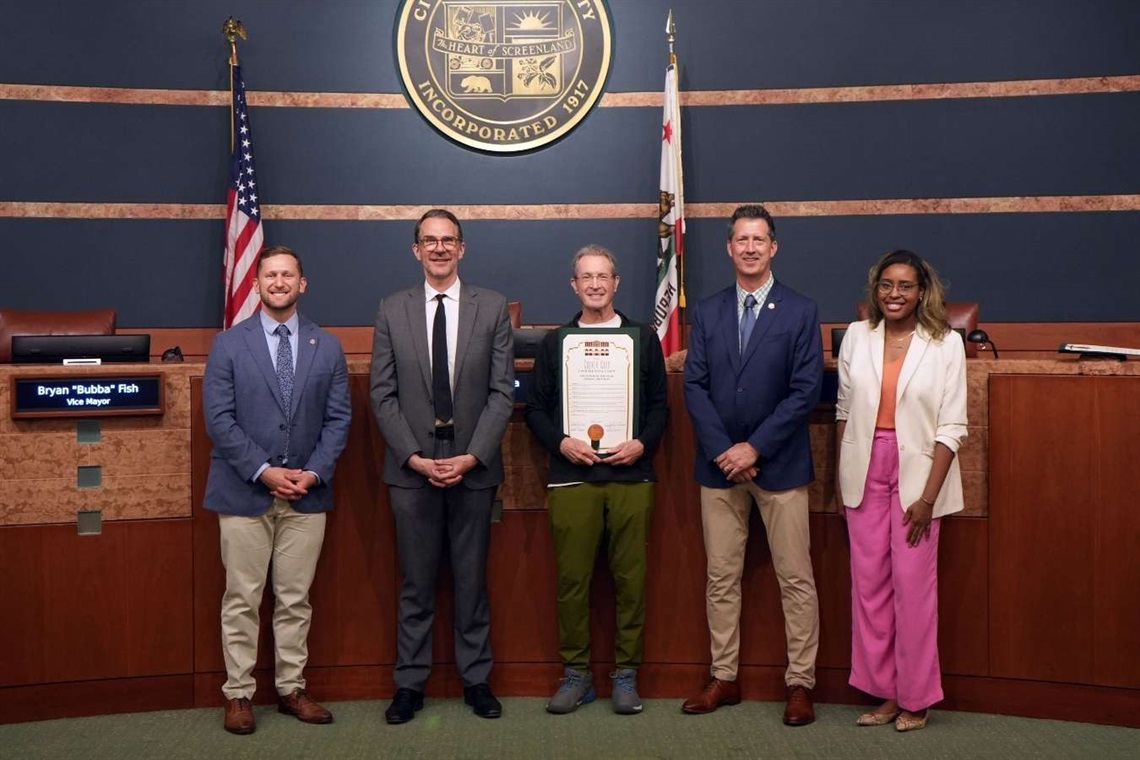
The City Council commended Michael Monagan as the 2026 Senior of the Year for his outstanding service and contributions to the Culver City community. Monagan was recognized for more than 30 years as a Special Education teacher, his civic service through CERT and poll work, his volunteerism, and his role in strengthening community connections through music and local events.
The City Council proclaimed May 2026 as ALS Awareness Month in Culver City, raising awareness of Amyotrophic Lateral Sclerosis, also known as Lou Gehrig’s disease. The proclamation recognized the impact of ALS on individuals, families, caregivers, and the broader community, while encouraging continued support for research, care, advocacy, and efforts toward better treatments and cures.
The City Council also proclaimed May 2026 as Historic Preservation Month in Culver City, recognizing preservation as a tool for honoring community history, maintaining neighborhood character, supporting economic development, and strengthening civic pride. This year’s theme, “All People Are Created Equal,” highlights the importance of preserving places that tell the full American story.
Additional Council Decisions
Additional items approved by the City Council include:
- Approved cash disbursements from April 18, 2026 to May 1, 2026.
- Approved the minutes of the City Council meeting held on April 27, 2026.
- Adopted an ordinance, amending Culver City Municipal Code, allowing for an Entertainment Zone to be established in Downtown Culver City during special events.
- Waived competitive bidding procedures and approved a five-year professional services agreement with Dr. David Eisner in an amount not-to-exceed $65,000 annually for the provision of medical director services for the Culver City Fire Department.
- Adopted a resolution in support of the inclusion of Ballona Creek in the Los Angeles Coastal Area, California, Special Resource Study by the National Park Service, and authorizing and directing the City Manager to submit a copy of the Resolution to the National Park Service.
- Approved an amendment to the general services agreement with Trueline Construction & Surfacing, Inc. to increase the maximum compensation amount by $50,894, for a total not-to-exceed amount of $315,511 to support the expansion of the scope of services, including the resurfacing and repairs to multiple City park outdoor sports courts.
- Approved a second amendment to the on-call professional services agreement with Kreuzer Consulting Group for additional projects and related expenses.
- Approved a purchase order with National Auto Fleet Group for the purchase of two heavy-duty Commercial Chassis Cab Trucks (Ford F-550) in an amount not to exceed $401,622.24.
- Ratified termination of an agreement with Elevators Etc. and approved an agreement with SmartRise Elevators, Inc. to maintain and repair 13 elevators at nine facilities in an amount not to exceed $314,375 effective from June 1, 2026 to June 30, 2029.
- Approved an agreement with EnCharge for the installation and operation of electric vehicle (EV) charging stations, including revenue sharing, at the future Culver Commons Parking Structure located at Washington Boulevard and Centinela Avenue as well as approve a change order in the amount of $84,375 to Culver Public Market, LLC related to this EV conduit infrastructure.
- Adopted a resolution amending the regular meetings of the City Council for the calendar year 2026 and rescinding Resolution R2025-090.
Additional Information
Additional information about each of the topics heard at the City Council meeting can be found in the staff reports and backup attachments for the items, which are posted along with the agenda to the City’s website. The video of the City Council meeting is available on the City’s website for viewing.
The next City Council meeting will take place after Memorial Day on Tuesday, May 26, 2026. Childcare is available for the meeting for families wanting to attend in person by emailing PRCS at prcs.department@culvercity.gov or calling (310) 253-5560.